
Giving Feedback: Are you Focused on Justice or Growth?
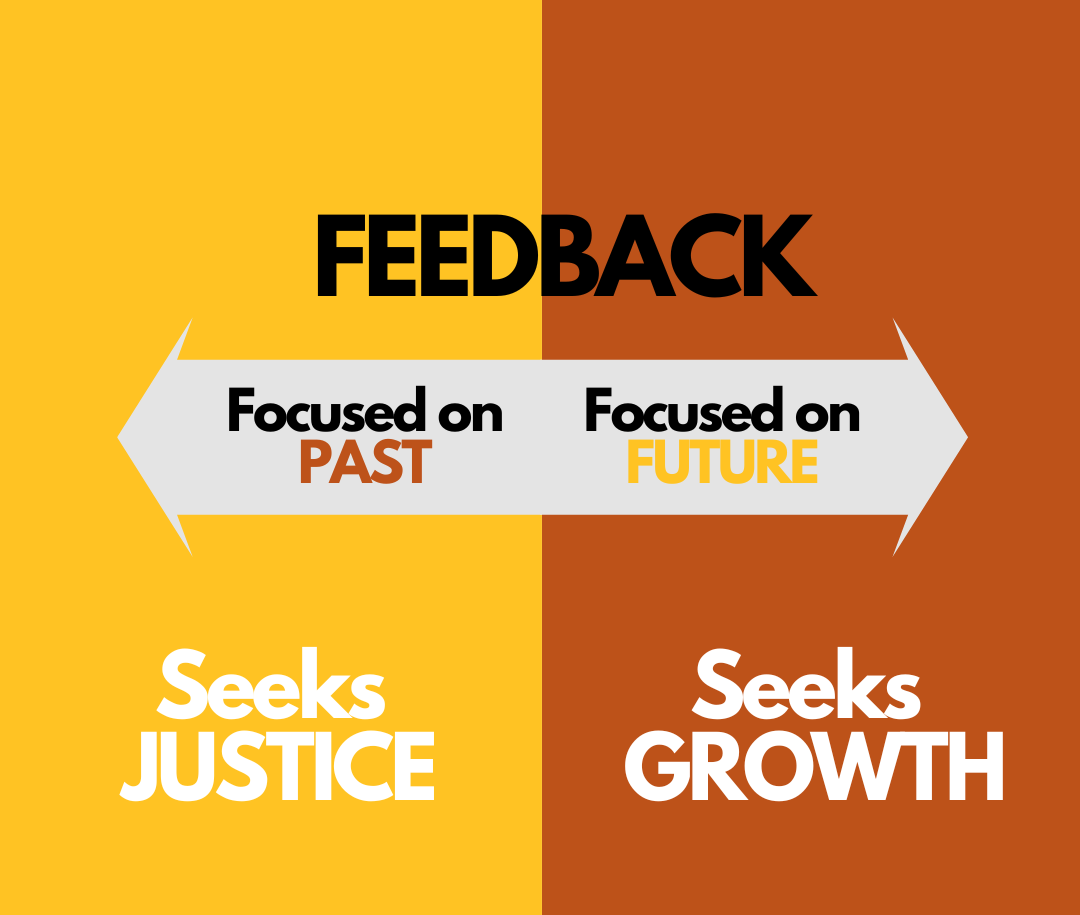
How we give feedback is rarely neutral. Behind every comment, question, or observation sits an intention, often unspoken, yet strongly felt.
In leadership teams, feedback is frequently framed as a skill. We talk about phrasing, models, timing, and structure. Yet what shapes the impact of feedback most is not technique, but orientation, specifically whether feedback is rooted in justice or in growth. This distinction matters more than we tend to acknowledge.
When feedback looks backward
When feedback comes from a place of justice, attention is directed toward the past.
The focus is on what went wrong, who was responsible, and how to restore a sense of fairness or correctness.
This orientation is deeply human. Our nervous systems are wired to detect threat, error, and unfairness. Research in cognitive psychology consistently shows that negative events carry more psychological weight than positive ones, a phenomenon known as the negativity bias.
In organizational settings, however, justice-oriented feedback often carries unintended consequences. It tends to invite defensiveness rather than reflection, trigger self-protection rather than learning, and narrow attention rather than expand it.
Research on psychological safety by Amy Edmondson shows that when people fear blame or punishment, they are significantly less likely to speak up, admit errors, or ask for help. In her studies of teams across healthcare, manufacturing, and knowledge work, environments with low psychological safety consistently showed lower error reporting, not because fewer errors occurred, but because people worked harder to hide them.
Why blame shuts learning down
Feedback that is perceived as judgment activates threat responses in the brain. Under these conditions, cognitive resources shift away from reflection, perspective-taking, and learning.
Research summarized in Harvard Business Review has repeatedly shown that stress and social threat impair working memory, reduce cognitive flexibility, and increase reliance on habitual responses. This is precisely the opposite of what feedback is meant to achieve.
Justice may satisfy a short-term need to correct or clarify. It rarely produces sustained behavioral change.
When feedback looks forward
When feedback comes from a place of growth, attention shifts to the future.
The focus is on learning, improvement, and building the conditions so that what did not work is understood and not repeated.
Growth-oriented feedback is less concerned with proving a point and more concerned with increasing capability. Instead of asking who was right or why something failed, it asks what can be done differently next time and what conditions would support a better outcome.
This future-focused orientation aligns closely with findings from learning science. Studies in adult learning and organizational behavior consistently show that people are more likely to change behavior when feedback is framed as input for improvement rather than as an evaluation of past performance.
Research on learning organizations emphasizes that sustainable performance depends less on individual correction and more on shared inquiry. As Peter Senge notes, people do not resist change itself, they resist being changed.
Growth-oriented feedback invites participation. Justice-oriented feedback imposes conclusions.
Intention shapes the system
What often gets missed in feedback conversations is that intention does not stay internal. It shapes tone, body language, pacing, and the kinds of questions that get asked.
People are highly sensitive to whether feedback is meant to restore control, assign responsibility, or enable learning. Even when words are carefully chosen, intention tends to leak through.
Research on trust and leadership consistently shows that perceived intent is one of the strongest predictors of how messages are received. What people believe you are trying to do matters as much as what you say.
This helps explain why two leaders can deliver nearly identical feedback using the same framework and still produce very different outcomes.
Justice and growth are not opposites
Justice and growth are not mutually exclusive. Accountability matters. Standards matter. Fairness matters. The question is not whether justice has a place, but when it leads and when it follows.
In high-performing teams, justice is often embedded in clear expectations, transparent processes, and shared norms, rather than delivered retrospectively through feedback conversations.
Feedback itself, when the goal is behavior change, works best when it is oriented toward growth.
The leadership implication
For leaders, the shift is subtle but consequential. Before giving feedback, the most useful question may not be what needs to be said, but what is being created.
If the intention is to be right, correct the past, or settle something unresolved, the impact will likely be limited.
If the intention is to strengthen capability, build trust, and improve future outcomes, the same feedback becomes a lever for learning.
Over time, teams learn not just from what leaders say, but from where their attention consistently points.
A final reflection
The impact of feedback is shaped less by technique and more by intention.
Justice looks backward.
Growth looks forward.
➝ If you want to strengthen feedback skills within your own teams, take a look at our Corporate Programs.