
Doing Hard Things The Human Way
Flash back 25 years ago, I'm in a meeting room on the 19th floor on my old office building on Park Avenue in New York. I am an Associate Consultant, presenting the outcome of a long and demanding project, that had consumed weeks of work and countless late nights.
A senior partner dismissed the work with sharp words, quick judgment, no pause to ask or understand. I remember standing there, maintaining composure, while repeating a single phrase to myself:
“Don’t cry, don’t cry, don’t cry.”
At the time, I thought that was strength and frankly, that was what everyone else around me was doing. Staying unaffected and holding back emotion. Years later, I realized it was strength of a different kind that was trying to surface. The kind that values honesty, care, and the courage to stay human even in hard moments.
That's why now, most of my work has to do with empathetic leadership. It’s become a passion in our corporate trainings and my executive coaching engagements, not only because it’s effective, but also because it’s deeply personal to me.
For many years, I worked in corporate and management consulting, during a time when transactional leadership was the norm.
The underlying agreement was simple: I need something from you, you will provide it, and you will be compensated. It was a clear, rational exchange, efficient, measurable, and seemingly fair.
But it was also short-term, since it relied on compliance (or other singular incentives such as monetary) rather than connection, and it left little room for emotion, compassion, or humanity.
When I start teaching about empathetic leadership, I often need to start with a disclaimer. It is not about being soft or agreeable.
It’s about seeing the person behind the performance, about making space for our humanness without losing accountability, and about leading with both head and heart.
Transactional vs Heart-Centered Leadership
Here’s what I’ve learned along the way about the two distinct ways of leading people:
↳Transactional leadership focuses on getting things done.
⇒ Empathetic leadership focuses on how people feel and grow while getting them done.
↳Transactional leadership drives results through control and structure.
⇒ Empathetic leadership inspires results through trust and understanding.
↳ Transactional leadership treats emotion as noise to be managed.
⇒ Empathetic leadership listens to emotion as data that reveals what matters.
↳Transactional leadership pushes for performance at any cost.
⇒ Empathetic leadership balances performance with sustainability.
↳ And most importantely, while transactional leadership wins compliance,
⇒ Empathetic leadership earns commitment again and again and again.
The best way to define empathetic leadership for me is:
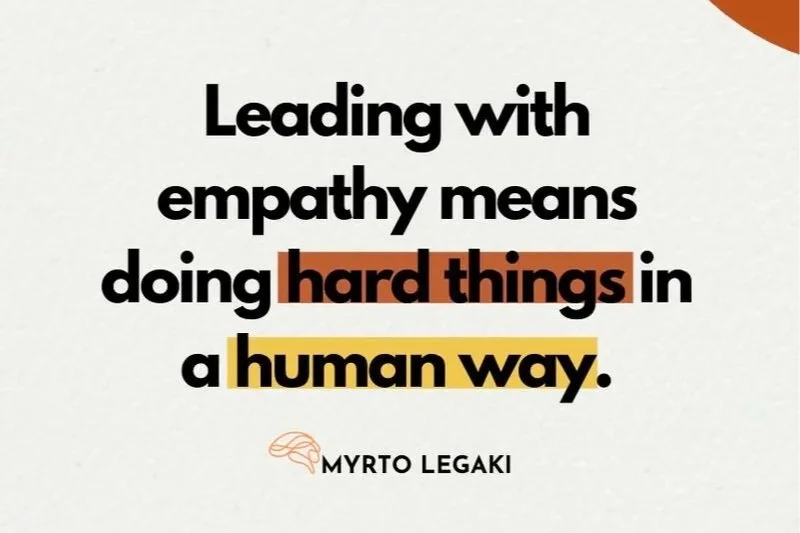
“Doing hard things, in a human human way.”
And sometimes, that's the hardest thing to accomplish.